Authors
We're publishing a series of posts helping make sense of price transparency regulations. Read our overview of the No Surprises Act here.
The industry has seen balance billing legislation before on a state level, with over 30 states having implemented their own balance billing laws. Because states do not have regulatory authority over self-insured plans due to ERISA, self-insured employers have not been subject these laws. This means that nearly 70% of Americans who receive coverage from their employers have not benefited from the protection of these laws. How does this federal legislation impact self-insured employers?
Which organizations are subject to the No Surprises Act? The No Surprises Act applies not only to individual and group health insurance plans offered by health insurers, but also to all group health plans offered by employers. This includes self-insured plans and grandfathered plans. [1] Between employers, brokers and consultants, third party administrators, and insurance companies, various stakeholders will have a role to play in keeping payers compliant.
Which parties will be held accountable under the Act? Like the preceding health insurance transparency act (Final Rule), the enforcement of this act falls along the lines of enforcement drawn in the Affordable Care Act. [2] That means that while self-insured plan sponsors may work with third parties to provide all the necessary information to patients, they will ultimately be responsible for compliance. On the other hand, if a fully-insured plan sponsor contracts with a third party, that third party may be responsible for compliance. [3]
What is the penalty for noncompliance? While the Act specifies penalties for provider noncompliance, there are no separate penalties identified for health plan noncompliance. Instead, the penalty established through the ACA likely will be leveraged for the No Surprises Act. In that case, we can expect health plans to be fined $100 a day for each affected individual in the case of non-compliance. [4]
Who will be enforcing the No Surprises Act? Enforcement follows the rules established by the Affordable Care Act: the Department of Labor will regulate self-insured plans, while fully insured plans will continue to be regulated by states.
How will the No Surprises Act be enforced? The government will audit up to 25 health plans a year to ensure compliance with the Act starting in 2022. If the government receives a consumer complaint, it can audit that consumer’s health plan.
What other questions do you have about the No Surprises Act and other price transparency legislation? Send them to info@turquoise.health
- The Commonwealth Fund: Summary of the No Surprises Act ↩︎
- National Law Review: Many Surprises for Payors and Providers in No Surprises Act ↩︎
- Health Affairs: Trump Administration Finalizes Transparency Rule For Health Insurers ↩︎
- Congressional Research Service: Surprise Billing in Private Health Insurance:
Overview and Federal Policy Considerations ↩︎
Related resources
Learn, listen, and watch the latest on price transparency.
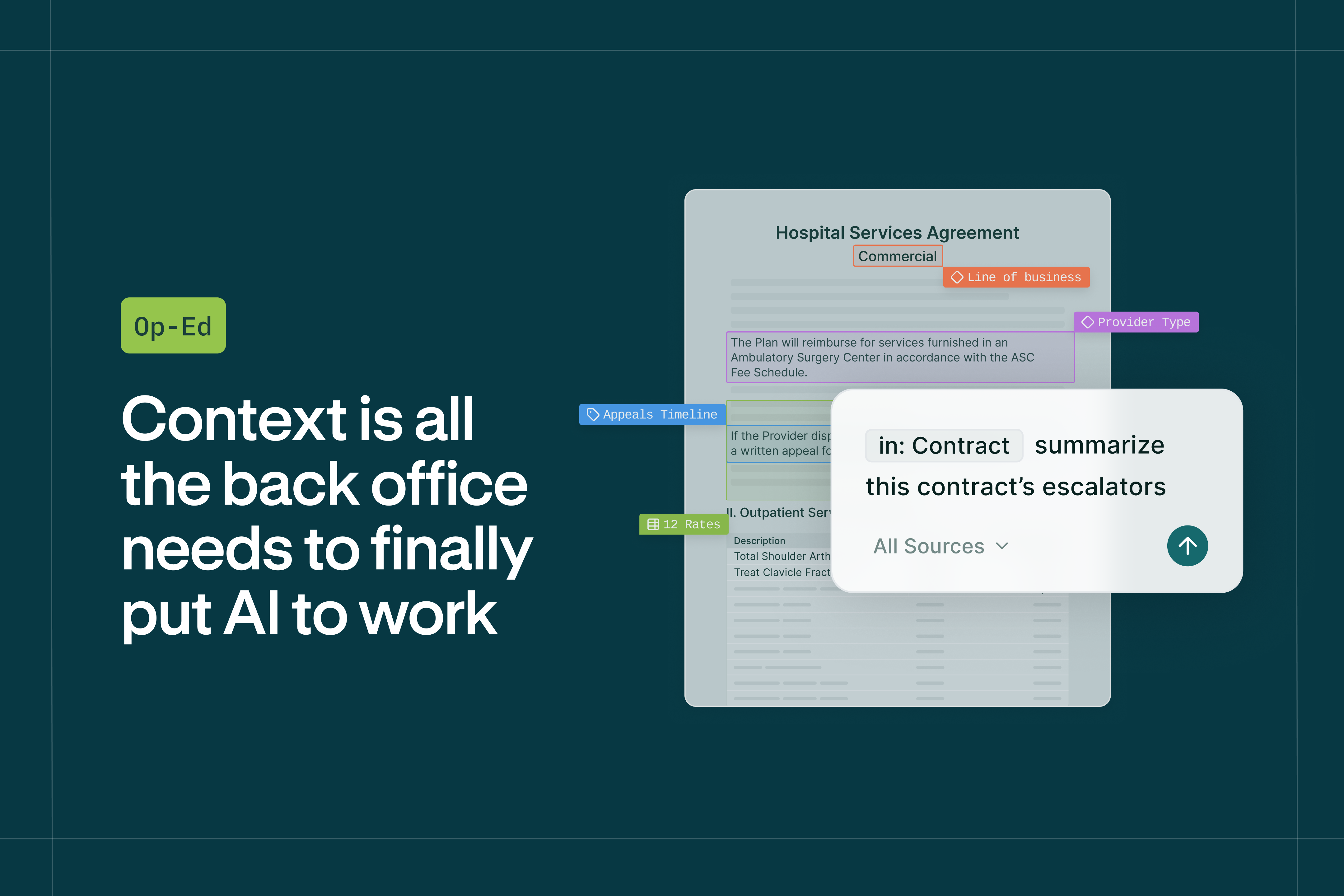
Context Is The Secret to Making LLMs Actually Work in Healthcare Back Offices
For the back office, the data that matters most to you lives where big tech can’t get it: your contracts