Authors

The competition for AI training data is fierce. Having already consumed everything online, AI labs are now buying and scanning rare books by the truckload to get access to more information. But for healthcare back offices, the data that matters most lives where big tech can’t get it: in dusty filing cabinets, scanned PDFs dumped in company SharePoint folders, and in veteran employees' heads.
That is why, despite recent advances in AI, its impact in healthcare back offices has been limited. As a Co-Founder of Turquoise with a long history of working in and teaching machine learning and AI, I’ve seen this firsthand. An AI model, however amazing, is only half of the solution. Like a human, even the best AI model needs to understand your industry and business to handle complex tasks. It needs to be onboarded to your company the same way a new employee would.
Research has found that LLMs are more than three times as accurate when given access to business context, rather than relying only on the model's own knowledge. Subsequent research has shown that knowledge graphs that combine data with relationships make models even more accurate, reduce mistakes, and more often lead users to the intended result.
This means that to deploy AI successfully, there are two critical questions you must answer:
- Are we deploying an AI model capable of handling the problem at a reasonable cost?
- How are we supplying the model with internal and external context it needs to accurately solve the problem?
Most organizations evaluating AI spend nearly all of their resources on the first question. But everyone has access to the same AI models, and model improvements are a rising tide that lifts all boats. Business context is where AI initiatives in healthcare billing succeed or fail. The models are already really, really good, but they can’t work without access to all the information they need to do their job.
Let's take a question that CFOs ask daily: "Are we collecting what we are owed, and are we getting paid fairly for value?" To answer this question, an AI system must first understand the costs involved in each patient encounter, then scale that capability across the entire book of business.
Imagine that the system needs to estimate the cost for a cardiac ablation procedure at the Texas Heart Institute, a center of excellence based in Houston. If you ask the latest Claude or ChatGPT models for a cost, they will give you abstract answers about the difficulty of providing accurate estimates and direct you to call a billing counselor. But any expert biller would know that the Texas Heart Institute is a joint venture between two health systems, thus potentially requiring bills from multiple parties, that billing depends heavily on inpatient vs. outpatient treatment, that the patient's insurance plan and yearly benefits would need to be considered, and that all the facilities involved publish high-quality pricing data. With a little time, a biller could put together a solid estimate. But the twist is that, with access to the same context, an AI model can handle the task just as easily, and a lot faster.
Three Guidelines to Maximize the Benefits of Context
Here are three best practices to unlock the power of AI models with business context.
Provide Accurate, Consistent Context
AI models treat the contextual information you provide them as fact. If they are given erroneous information, they will produce poor results. As the old saying goes, 'Garbage in, Garbage out'.
In healthcare, the data doesn't just live in different places. It's also labeled, sorted, and categorized differently in each place. The same procedure, provider, or plan can show up under different names and groupings depending on who recorded it. Because none of it maps one-to-one, tying the relevant pieces of context together is critical.
Combining high-quality datasets with AI models produces exponential results. At Turquoise, that's why we've built our Reimbursement Graph: a dataset of all payers and providers in healthcare, the procedure variants they can perform, and how much everyone gets paid. With this information, our AI systems can reliably answer billing questions by combining the reasoning of the latest AI models with the same facts a billing expert would use to solve the problem by hand.
Provide Exclusive Context
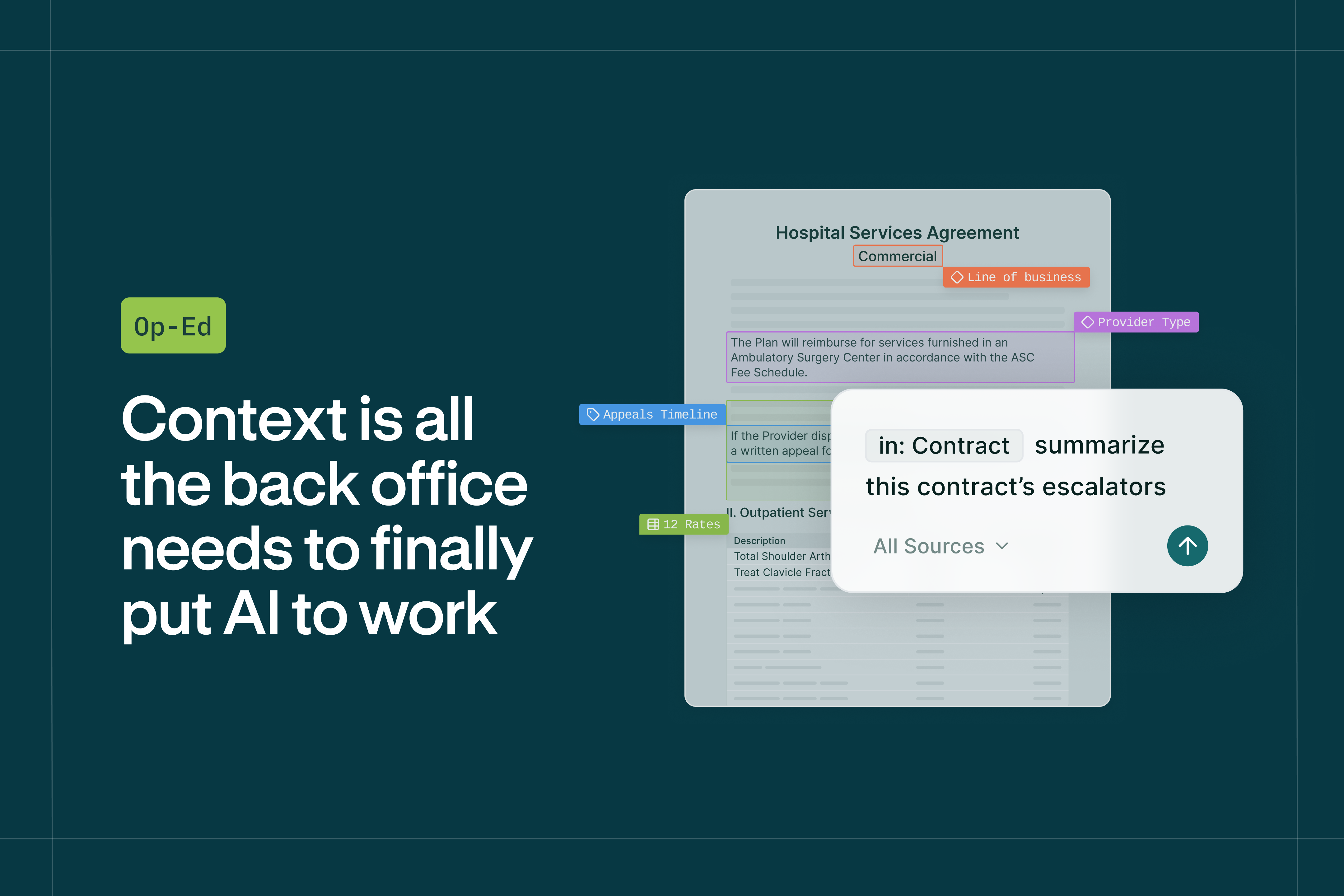
Your industry and internal company knowledge is the missing puzzle piece to unlock the power of AI. The latest AI models are trained on all publicly available knowledge. But they can't access the information you hold internally.
That’s why we've built a system that extracts data from dusty contracts and PDF scans and reconstructs it into data that can be joined with our Reimbursement Graph. Our contracts platform uses the latest AI models to scan contracts, extract the billing and legal logic they contain, and match it to the broader healthcare dataset. As a result, users get a high-resolution view of their own billing rules and logic, joined with a medium-resolution view of the entire healthcare landscape's billing logic.
Keep Context Relevant
With AI systems, more isn’t always better. AI systems perform best when they can see exactly the information needed to solve the problem and nothing else.
Just as companies in decades past invested in organizing their filing cabinets, AI systems need the same data organization. The latest research shows that AI models perform best when given only the information relevant to the problem, and too much unrelated information overwhelms them and leads to poor results (Gao et al., 2026).
When you ask questions or process data, our AI models retrieve the relevant information to solve the problem: business relationships, provider offerings, insurance network details, contracting rules, and more. The contextual data provided to the AI model needs to be organized so it can pull in only the relevant facts. For best results, connect the AI model to an information retrieval system that has access to all of the company’s key information. When the user asks a question or takes an action, the system fetches the required supporting information and disambiguates confusing terms. And just as you might ask someone clarifying questions, the system needs to be able to do that when it is confused.
The Part of the System That's Yours
Choosing the best AI model for the task is still critical. Running the wrong model on the wrong task either results in poor performance or runs up unneeded costs. Matching the right model to the right task is worth getting right. But every organization has the same model choices.
The real competitive advantage comes from business context. By combining deep context with the latest AI reasoning capabilities, the system can solve complex problems at scale. Your context is the only part of that system that's yours. Build your AI tools on it, or partner with vendors who already know it. At Turquoise, that's what we've built our platform to do.
Related resources
Learn, listen, and watch the latest on price transparency.

Turquoise is now available in ChatGPT for Healthcare
We've joined OpenAI's new healthcare plugin lineup
CY 2027 OPPS Final Rule: What the 340B Changes Mean for Hospitals, Patients, and Pharma
CMS will pay 340B hospitals ASP minus 28% for drugs starting January 1, 2027, down from ASP plus 6%
Transparency in Coverage Final Rule (2026): What Changes for Payer Machine-Readable Files
Payers will report by network instead of plan, move from monthly to quarterly, and attest to their data. We expect files to be slimmed down, more organized, and easier to find online.