
Authors

A colonoscopy in NYC costs anywhere from $500 to $9,000. The only difference? Which door you walk through. Healthcare is one of the few major purchases in American life made without a price tag. Patients are expected to commit to care—often urgently, sometimes emotionally—without knowing what it will cost until weeks or months later. By the time the bill arrives, the choice has already been made and you’re on the hook.
This is not for lack of information. The data exists. You can actually put a price on healthcare. But those prices are buried beneath layers of billing codes, contractual rates, and benefit designs opaque even to experts. The consequences of that complexity are widely felt and well documented. More than 100 million Americans carry medical debt (PayZen). High healthcare spending crowds out wages and savings and is a major source of household financial strain.
Even when providers offer discounted cash prices, most services beyond routine visits and simple procedures remain out of reach. A recent survey found that 75% of uninsured adults under 65 went without needed care because of the cost (KFF). When patients can understand their options, compare prices, and anticipate costs, the balance of power begins to shift.
This is not a failure of individual responsibility. It is a structural problem—one that policymakers, technologists, and local governments in New York are beginning to confront with the launch of New York’s Health Care Price Comparison Tool. New Yorkers can now search, compare, and get an estimate before they even make an appointment. This groundbreaking tool is the first of its kind, but why did it take until 2026 for it to happen?
Legislation as an effective catalyst for change
Since 2020, federal policymakers have taken meaningful (if incomplete) steps to fix healthcare’s transparency problem. The Hospital Price Transparency Final Rule (2021) required hospitals to disclose standard charges and insurer-specific negotiated rates. The Transparency in Coverage Final Rule (2022) required most health plans to publish machine-readable files of in-network negotiated rates and out-of-network allowed amounts. The No Surprises Act (2021) protects patients from unexpected out-of-network bills and requires good-faith estimates for uninsured and self-pay patients.
Together, these policies were meant to make healthcare prices visible, comparable, and predictable. In practice, the price data has been vast, fragmented, and largely unusable for the very constituents it was meant to serve. That’s where technology steps in.
Turquoise turned mandates into meaning and now, action
Turquoise Health was founded in 2020 to help close the gap between complex healthcare administration and patients. We built the infrastructure to ingest, cleanse, and normalize massive volumes of price transparency data, and developed deep expertise in the contract methodologies that determine how care is billed and paid for.
We knew all along that raw, code-level data was not enough to close the gap for patients. Most medical claims include multiple codes, and it is their interaction, not any single line item, that determines what insurers and patients ultimately pay. But we had to wait for our own technology to catch up. Four years into product development, we created a blueprint for healthcare administrative reform: the Publicly Accountable Transparent Interoperable Efficient Nonproprietary Transaction Standard (PATIENTS) Framework. A key dimension of that framework is Standard Service Packages (SSPs), an open-license methodology that bundles services and fees to more closely resemble a real claim. Those services are mapped to insurance benefits and integrated with real-time eligibility data to generate personalized estimates for patients.
While no tool can predict every billing variation, Turquoise produces the most comprehensive and personalized cost estimates available.
New York made it personal
In 2024, New York City took a bold step. Local Law 844-A, or the Healthcare Accountability and Consumer Protection Act, created the nation’s first Office of Healthcare Accountability. The law requires the city to collect, analyze, and publicly share data on hospital pricing, insurer costs, and healthcare spending, enabling New Yorkers to compare prices across providers and better understand where healthcare dollars go.
In 2025, NYC Health partnered with Turquoise to help deliver on that promise.
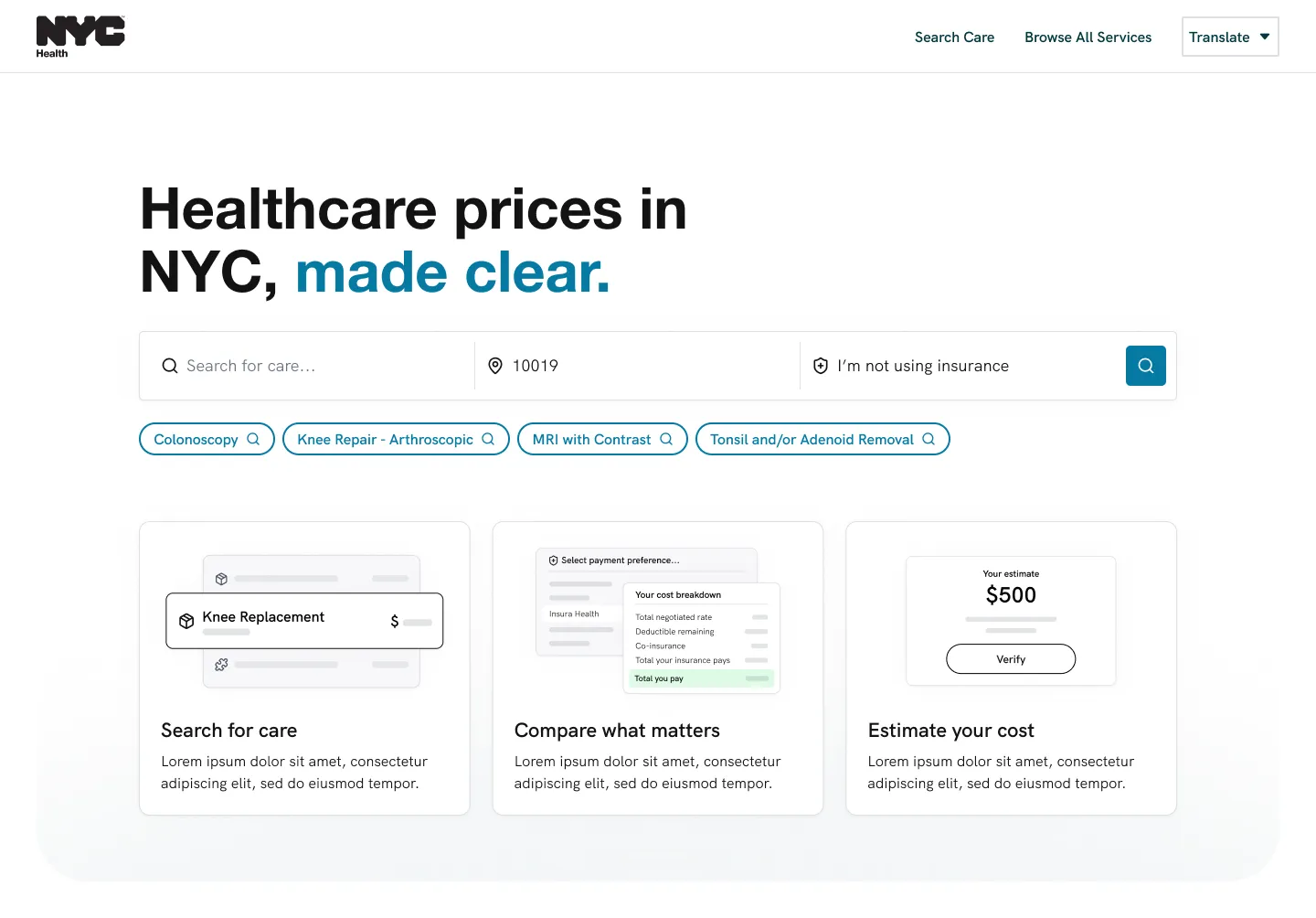
The result is the first iteration of the NYC Health Care Price Comparison Tool. It allows New Yorkers to compare prices for 33 common services,from labor and delivery to MRIs,across hospitals, ambulatory surgery centers, and imaging centers citywide. Users can also generate personalized out-of-pocket estimates for in-network care across 12 major commercial plans and three Essential Plans, as well as self-pay options for uninsured patients.
This is only the beginning. We plan to expand both the range of services and insurance options throughout 2026 and beyond.
The tool was designed with patients, not policy checklists, in mind. Accuracy and completeness were table stakes. Equal weight was given to usability, accessibility, and education. The experience is meant to feel navigable, human, and grounded in real-world needs. And yes, it even helps you find the subway station nearest to your provider. We ❤️ New York!
The power in clarity
While the first of its kind, this tool is the first of many. Price transparency alone will not fix healthcare. But clarity is a prerequisite for fairness and trust. New Yorkers: visit to compare prices before your next appointment. Everyone else: ask your city why they don't have this yet.
Interested in offering upfront prices on healthcare for your city? We’d love to hear from you!
See inside the black box
Traceable data, unified workflows, and total transparency
Related resources
Learn, listen, and watch the latest on price transparency.
Transparency in Coverage Final Rule (2026): What Changes for Payer Machine-Readable Files
Payers will report by network instead of plan, move from monthly to quarterly, and attest to their data. We expect files to be slimmed down, more organized, and easier to find online.
Prescription Drugs Rates Get A Mandated Due Date with Dec 2027 Enforcement
What this means for manufacturers ability to provide patients a personalized OOP cost for drugs
Transparency in Coverage Update Trims Down Payer MRFs & Brings Back the Rx File
CMS's first major TiC overhaul since 2022 simplifies payer files and sets a December 2027 enforcement date for the prescription drug file. Here's what it means for patients and the industry