Authors


Good morning, Baltimore! Today’s opening musical number is about price transparency regulation and legislation for pharmaceuticals. The topic is coming up frequently these days because, within a relatively narrow view of pharmaceutical pricing data, we’ve had a wide range of starts and stops: indefinitely delayed requirements, requirements with enforcement delays that began and ended, and currently, there’s a pending Congressional vote to consider.
Let’s run through each scenario.
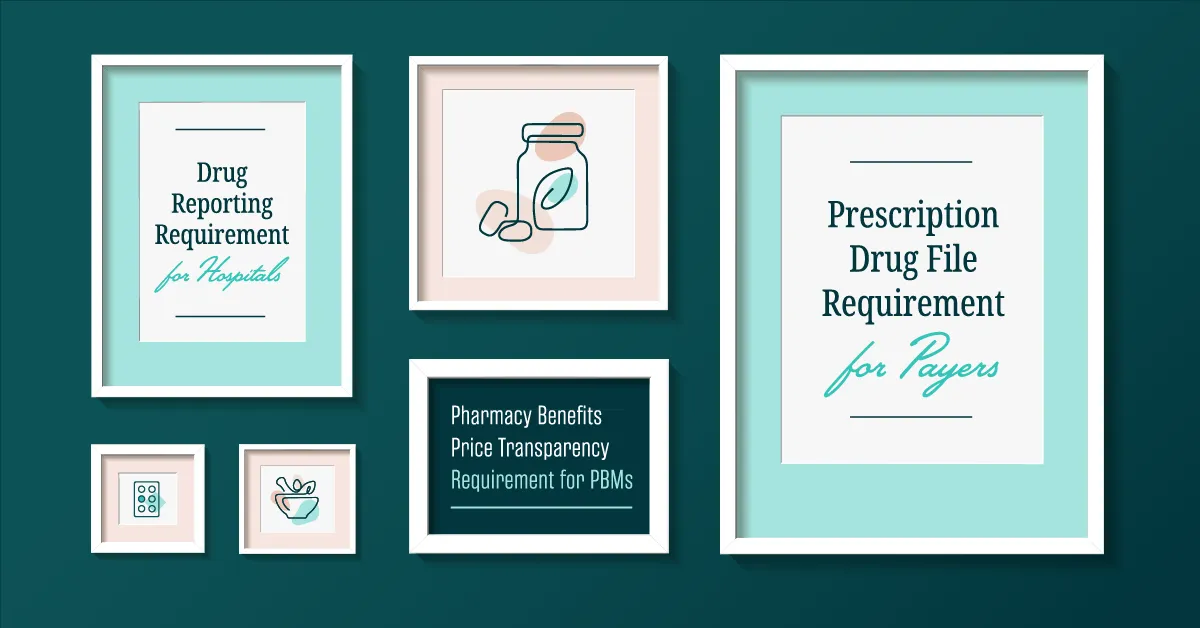
Drug Reporting Requirement for Hospitals | Effective 1/1/25
Similar to the dynamic between the Hospital Price Transparency Rule (aka price transparency requirements for hospitals) and Transparency in Coverage Final Rule (TiC) (aka price transparency requirements for payers), pharmaceutical price transparency regulation is mirrored between hospitals and payers via two different requirements. The first requirement is detailed in the 2024 Hospital Price Transparency Final Rule.
The Drug Reporting Requirement, effective 1/1/25, mandates hospitals to publish a machine-readable file (MRF) containing the following information for all drugs within the hospital’s chargemaster (CDM):
- Gross Charge: Charge for an individual item or service reflected in the hospital’s chargemaster (i.e. list price)
- Discounted Cash Price: Charge for an item or service administered by the hospital to a patient who will pay in cash or a cash equivalent
- Payer-Specific Negotiated Charge: Charge negotiated with a third-party payer for an item or service
- De-Identified Minimum Negotiated Charge: Lowest charge a hospital has negotiated with all third-party payers for an item or service
- De-Identified Maximum Negotiated Charge: Highest charge a hospital has negotiated with all third-party payers for an item or service
- Drug Unit: The unit value that corresponds to the established standard charge for the drug
- Drug Type of Measurement: The measurement type that corresponds to the established standard charge for drugs based on a list of options
This is the second iteration of MRF requirements for hospitals. Compounding with the new hospital MRF schema (effective 7/1/24), we eagerly await the wealth of information these files will provide. Drugs, like the rest of healthcare items and services, have existed in a black box of cost for too long and are often less organized than other CDM line items. Transparency into the cost of these drugs will invite natural economic forces to the party. And reader, we love us a good transparent party.
Prescription Drug File Requirement for Payers
The Prescription Drug File Requirement comes from TiC. The overachievers in the room will remember that TiC mandates three MRFs.
- In-Network Rate File: rates for all covered items and services between the plan or issuer and in-network providers.
- Allowed Amount File: allowed amounts for, and billed charges from, out-of-network providers.
- Prescription Drugs File: negotiated rate and historical net price.
Files 1 and 2 have been enforced since 7/1/22, but the third file was indefinitely delayed…until recently! Last September, CMS released FAQs About Affordable Care Act Implementation Part 61, which included updates related to the Prescription Drugs File MRF requirements from TiC. The Part 61 FAQs ended the enforcement deferral period for the prescription drugs MRF. While this file is back in the realm of possibility, an enforcement date has yet to be announced pending a commitment from CMS: “The Departments intend to develop technical requirements and an implementation timeline in future guidance.”
Once an effective date is announced, the Prescription Drug file must contain the following required elements:
- HIOS ID or EIN: Health Insurance Oversight System Identification or Employer Identification Number, as applicable
- Billing Code: DRG, CPT, HCPCS, NDC, or other common identifier such as revenue code
- Place of Service Code: two-digit codes that are placed on
- professional claims, including Medicare, Medicaid, and private insurance, to indicate the setting in which a service was provided
- TIN & NPI: Tax Identification Number and National Provider Identifier
- Negotiated Rates: Charges negotiated with a third-party provider or hospital for items or services
- Historical Net Prices: the retrospective average amount a plan or issuer paid for a prescription drug, inclusive of any reasonably allocated rebates, discounts, chargebacks, fees, and any additional price concessions received by the plan or issuer with respect to the prescription drug
Some technicalities: NDC reports negotiated rates, and Historical Net Prices need to be calculated based on a 90-day lookback period beginning 180 days before file publication date. Discounts for 340B-eligible drugs will be excluded from the file.
Thankfully, some drug rates are already made public thanks to hospital MRFs. Part B injectable drugs are included in hospital MRFs because hospital files must be built on all items and services within a hospital’s CDM. Using innovative technical wizardry, Turquoise has been able to glean insights and per-unit pricing from those hospital MRFs. The addition of a payer-created file specifically dedicated to prescription drugs furthers that progress tenfold.
Pharmacy Benefits Price Transparency Requirement for PBMs
Within H.R.5378 (Lower Costs, More Transparency Act) Federal Bill Draft, the Pharmacy Benefits Price Transparency Requirement for PBMs (currently pending congressional approval) would mandate plans, insurers, or any entity/subsidiary providing PBM services to create and submit an MRF to group health plans. This would need to include a whole host of elements related to drug name, dispensing info, Wholesale Acquisition Cost (WAC), Average Wholesale Price (AWP), and numerous other cost, price, and usage information. You can read the full list of requirements here if you’re into details. Unlike payer MRFs under TiC which must be updated monthly, this file will need to be updated once every six months. A few select organizations have started to publish these files on a state-by-state basis, and like the overachievers we are, we’ve begun to parse these to get ready for prime time.
We believes that price transparency data only helps every industry stakeholder understand costs and pricing and allows economic forces to set fair market rates. As a result, we are dedicated to parsing the data that will come from the Prescription Drug Files, and we are hopeful PBM reporting requirements will pass in Congress.
Mark your calendars for 1/1/25
We’ve been around the Effective Date Block quite a few times by now but no matter how many times, it always seems to get here faster than we think. We have an MRF resources library your organization can leverage to better understand compliance of these new requirements. If your organization hasn’t even begun to think about compliance, feel free to give us a shout. We’re happy to help debunk or sort out those files on your behalf.
We firmly believe that come NYE 2024, you’ll be sitting, bubbly in hand, just waiting for those files to drop. These additional drug rates will round out the industry’s understanding of healthcare and show once and for all that even Pharma can take part in good faith efforts to create more transparency in healthcare.
Related resources
Learn, listen, and watch the latest on price transparency.
Transparency in Coverage Final Rule (2026): What Changes for Payer Machine-Readable Files
Payers will report by network instead of plan, move from monthly to quarterly, and attest to their data. We expect files to be slimmed down, more organized, and easier to find online.
Prescription Drugs Rates Get A Mandated Due Date with Dec 2027 Enforcement
What this means for manufacturers ability to provide patients a personalized OOP cost for drugs
Transparency in Coverage Update Trims Down Payer MRFs & Brings Back the Rx File
CMS's first major TiC overhaul since 2022 simplifies payer files and sets a December 2027 enforcement date for the prescription drug file. Here's what it means for patients and the industry