Authors
In the complex world of employee benefits, self-funded employers face unique challenges and opportunities. Chief among them: the Health Plan. Designing a plan around your population is complicated enough, couple that with network building and you’ve got quite the challenge. In the past, employers used outdated, bias-prone data. Today, we’ll explore how employers and their advisors can combine claims data with price transparency data to make strategic decisions around cost, quality, and access. And we'll do it with flair.
Out with the old, in with….
Most employers and advisors compare existing plans to benchmarks to make strategic decisions, plan changes, and evaluate potential changes and opportunities within plan design.
To do this, they typically leverage carrier-supplied discount analyses or reprice claims. This method works but it doesn’t work very well. It’s difficult to get up-to-date data and claims experience and sharing this sensitive data can be a challenge. Too often, these analyses are limited to large self-funded groups and only done when going out to bid for a new medical carrier. Not to mention the elephant in the room with these types of repricing analyses… you’re asking a salesperson to sell you on their product. Meaning, there is an inherent bias to the quality of the results.
It’s important to have an independent and unbiased party that can provide an agnostic and accurate viewpoint on network pricing. That’s where price transparency data comes in. This new data is taken from publicly available machine-readable files posted by both payers and hospitals. You can learn all about the regulations mandating this data, here. This is the singular, up-to-date source of truth for the cost of healthcare in the US.

Price transparency data is the secret to better benefits choices
Employers have often looked at healthcare spend as a black box. You don’t understand exactly what’s causing that 8-12% YoY increase. And if you do, it’s too late for you to do anything about it. Sometimes it’s not even about the cost itself but more about the unknown of the cost.
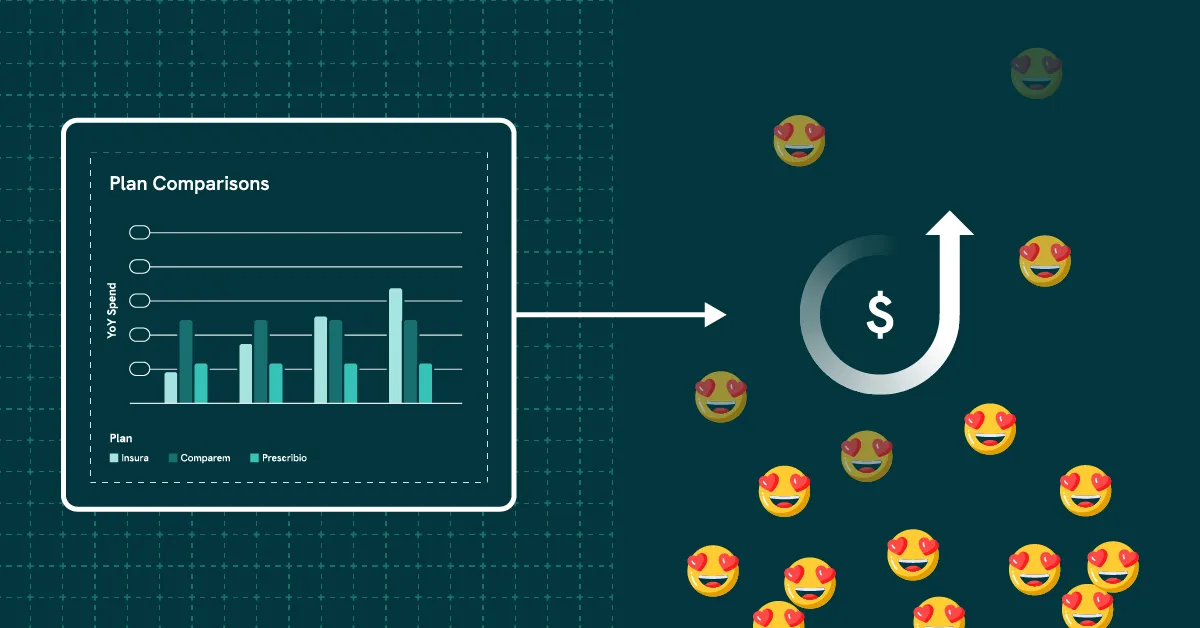
Price transparency enables employers and advisors to predict and get ahead of costs in a controllable manner. Using price transparency-powered software like Plan Check, you can now model and accurately predict costs. This means that each quarter, you’ll be able to highlight areas of opportunity within your plan.
In essence, here’s how it works: We take price transparency data and couple it with one of two choices: your claims files (no PHI needed) or a probabilistic service mix. We take that claims experience and reprice the claims on whichever plans of interest you have. For instance, you could say, “Our incumbent plan is the Cigna OAP plan and we want to reprice these claims across Aetna Choice POS, United Choice Plus, and our local Blues PPO plan.” This is the highest fidelity analysis you can do thanks to the specific claims file you’re using as the basis for the repricing.
We also developed a probabilistic services engine so you can still answer those same questions without needing to gather claims data. In this scenario, we’d take basic demographic information across age, gender, location, and workforce type for your population. From there, we generate a “look-alike” claims mix that is representative of your population inputs.
This enables better use of quality and access data
Price transparency also enables better use of quality and access data. Employers never want to decide on benefits purely on price. You want to consider quality and access in conjunction with the cost. If your benefits strategy is taking a quality-driven approach, price transparency data can help optimize where that spend goes. This ensures you’re driving care to the highest quality providers and understanding the financial impact of doing so.

Translating Data Into Plan Design
Price transparency illuminates opportunities for you to set up your plans to drive the right behaviors while considering cost. Say, for example, you’re looking at musculoskeletal (MSK) surgeries in the Houston metro area. The cost differences are consistent across all MSK-related procedures. But what about a specific MSK service: ACL surgeries?
Within a 10-minute drive of Houston city center, you can find yourself at three different hospitals, all with a 5-star CMS quality rating. Within one given network, the prices of ACL reconstructive surgery are:
Hospital A = $13,946.12
Hospital B = $17,035.00
Hospital C = $7,694.42
The price variances between these three track across most MSK procedures. So what can you do with this information? You now can design the right incentives to drive care to Hospital C where care is much cheaper (and still great quality) resulting in big savings without sacrificing quality. The right incentive for your population might be to create a $0 out-of-pocket program with Hospital C. Meaning if a member goes to Hospital C there is no deductible, co-pay, coinsurance, or any other member cost-sharing that you’d typically encounter with health plans. And maybe the right program might be to approach Hospital C and secure a direct contract with them. The opportunities are endless! With this data, you now have control and predictability of your spend.
All of these strategic decisions can be powered by price transparency data.
Better disruption control
Pausing for a moment, let me tell you a quick story: I grew up playing basketball. On one of my travel teams, we had an award for the “Biggest Disruptor.” To win this award, you had to disrupt the flow of the other team's offense and stymie their top scorers.
Contrary to being the biggest disruptor on the court, in benefits, you want to be a little more cognizant of the disruption you’re causing. Disruption in this context is when you make plan changes (like switching carriers and networks, changing plan design, etc.) that result in a disruption of healthcare utilization for your population. A tangible example of this would be if someone has to switch primary care providers because the benefits team switched carriers to a new health plan and that PCP now falls out-of-network. We aren’t winning any “Biggest Disruptor” awards for that.
By repricing claims using price transparency data, you can get a firm grasp on the level of disruption that certain plan changes will cause. You can then model out what percent of providers, spend, and claims will fall out-of-network if you were to make a switch. This enables you to determine if the level of disruption is okay (or not!) and then proceed with confidence in your decision.
Okay, but what about bidding for new carriers?
When is the right time to use price transparency data? Certainly, when you’re going out to bid for a new carrier, but there are other use cases you can take advantage of in between carrier shopping.
The power of price transparency is it serves as a great gut check to know:
- If you are in the right plan and network right now
- What opportunities and potential changes each plan year has
- COEs, network adequacy, evaluate on-site and near-site clinics, etc.
It serves as a great benchmarking tool to be able to understand one simple, giant question: “On XYZ Plan we would have spent $60M and on ABC Plan we would have spent $57M.”
Price transparency data offers unprecedented control for employers
Employers that leverage price transparency can have more control over cost, quality, and access for the healthcare of their employees. Gone are the days of using outdated discounts. Real data is available for you to make informed decisions. Transparency data goes much deeper and more specific at the provider level. Traditional discount analyses aren’t provider-specific. This makes modeling the cost of claims experience a challenge because, as we see in the transparency data, prices vary widely for the exact same services among providers and payers. Using real data ensures you’re not making best guesses, you’re actually making data-backed decisions.
Related resources
Learn, listen, and watch the latest on price transparency.
Transparency in Coverage Final Rule (2026): What Changes for Payer Machine-Readable Files
Payers will report by network instead of plan, move from monthly to quarterly, and attest to their data. We expect files to be slimmed down, more organized, and easier to find online.
Prescription Drugs Rates Get A Mandated Due Date with Dec 2027 Enforcement
What this means for manufacturers ability to provide patients a personalized OOP cost for drugs

Transparency in Coverage Update Trims Down Payer MRFs & Brings Back the Rx File
CMS's first major TiC overhaul since 2022 simplifies payer files and sets a December 2027 enforcement date for the prescription drug file. Here's what it means for patients and the industry